Showing posts with label "Shona McMillan". Show all posts

Thursday, 2 December 2010

WINTER HARE

Sunsets of pinks and purple hues and the ellusive Winter hare, as white as the snow covered land which it crosses so quietly.

This year the snow has arrived so early and in such quantity, it's been called the coldest spell to hit the UK for at least 17 years. Last year at this time, I was coming back from the Scottish Borders, crossing the Lammermuirs on the Duns road, the night sky sparkling with stars, moonlight casting long shadows across the land.


A sharp chill in the air I was driving slowly, scanning the road for the shine of black ice. Near to the view point over the Forth, I slowed the car to a crawl. Such a ghostly light, all along the Forth the hills were visible, snow reflecting back the moon's light through a cloudless sky. Not enough light for a photo or maybe, just one of these special nights that, as time passes, will become all the more memorable without a photo.  A personal, private recollection which becomes like a treasured feeling inside, a unique 'magical time' to be recalled.


Just before the road winds it way down the steepest of hills, having dropped my car to the slowest crawl -out from the snow at the side of the road, a pure White Winter Hare. So beautiful I stopped immediately and it stopped too, sitting up on its hind legs. I reached for my camera on the seat beside me but then, I let it go. I love to photograph hares but, somehow, this time felt different.


The hare dropped on to all fours and came towards me. Slowly I opened the door and got out. At the front of the car I stopped and the hare made a few more slow steps towards me. I crouched down and studied this creature of such beauty. Along the moors road there were no car lights in the distance, no sounds of any sort, just stars, moonlight and an intense cold. I shivered and, as slowly as it had appeared it crossed the road and moved across the land, it's white shape merging before me in to the snow and moonlight.


I have a friend who specialises in wildlife photography and I phoned him up the next day. He gave me a very plausible explanation. Dazzled by the car headlights the hare had been stunned by the light, when the effect passed it had continued on its way... Life can be full of mysteries, sometimes it is useful to look beneath the surface, to understand what factors have created a situation. But then again, there are also times when it's as good to just go with the flow and to enjoy the moment, the special moments which nourish the soul.


WINTER HARE ON THE DUNS ROAD

A full moon shone on the Lammermuir
As winter’s chill did still the air
When from the shadows, some hidden lair
Crossed my path, a snow white hare

It stopped to watch to stand and stare
Raised up slow and sniffed the air
This quiet being with no sign of fear
Serendipity? “I saw it there”

In moonlight shadow it seemed to sway
Some enchanted dance, as if its way
To welcome in a newborn day
The year ahead, come what may


All images and copy Shona McMillan ©
All Rights Reserved

Friday, 26 November 2010

LANGUAGE WITHOUT WORDS


Music: a universally shared language which crosses international boundaries.

Today, I was in Glasgow and Edinburgh city centres. I did not take my 'proper' camera with me but yes, my wee camera was tucked away in my bag. I was thankful I had that with me when the sound of beautiful music stopped me in my tracks. On this day, declared the coldest, worst November for snow in the UK for 17 years, an elderly lady was playing the accordion.

Her music went straight to my heart and I felt the sting of tears flowing in to my eyes. I knew I must go over to tell her how much I appreciated her playing.


From the other side of the street, she saw me approach. I smiled, I pointed to myself and made the action of playing the violin. Her face broke into a HUGE smile, excitedly she greeted me with a torrent of Romanian and then she repeated several times "violino violino violino" and touched her heart. I signed back "violino touched my heart" but took her hand and pointed to the accordion, then my heart - her music moved me.  She gestured to me to wait and changed to a play a waltz. Her head proudly lifted, her smile reflected by sparkling eyes as she played to me. I sang to accompany her and she swayed as she played. I took my camera from my pocket, touched my heart and she nodded, raised her hand to her lips and blew a kiss.

Me, in a smart red coat and black business trousers. This woman wrapped up against the cold, playing with one red and one blue glove and every so often, speaking to me in Romanian.

We must have looked an unusual pair but neither of us cared. 

People hurried past, to some we were invisible, to others there seemed almost a hostility in their expressions - "why were we taking?" I thought that few people in their assumptions would be correct.


This lovely lady was a musician like myself. I respected her skill, I understood and related to her in these short moments which we shared.  Like her, I had stood as a busker playing here and in other city centres in Scotland and around the world. I too, knew of  this experience happening 'now'. Many times I have met musicians on the road and the language of our countries has prevented verbal communication. Yet, music and gestures have shared what we have wanted to say. Music, a language without words.

Finally I had to go. She took my hand, gestured of the cold, pointed to the sun, pointed to my smile and signed that my smile had brightened and warmed her heart. For me, it was a long street to walk away from her and in her line of vision but, when I stopped to look back, she was still stood playing, smiling at me.


Catching the train back to Edinburgh, I arrived in the dark. The city centre was full of people rushing in and out of shops. Christmas lights illuminated Princes Street, yet the season of goodwill seemed more about spending money amidst loud music booming from the fun fair. The music here was not as sweet as the waltz played earlier to me by my friend. How much more precious had been her music, her smile and our shared exchange speaking a language without words.


If you have enjoyed reading my free Blog - maybe I can ask that, the next time you pass by a busker whose music you enjoy, please stop and give them some money. It takes many years of hard work and commitment to become a musician and there is a Celtic saying:

"A compliment doesn't pay the fiddler"

Thursday, 11 November 2010

REMEMBRANCE POPPIES

The delicate poppy has become a flower which symbolises different things to different people.

The Common Corn Poppy (Papaver Rhoesa) - its seeds hidden in the ground, has risen to flourish from distrurbed land and in the carnage of WW1 it flowered in abundance in war torn areas where so many lost their lives. In area of large open farmland, Flanders covers the neighbouring parts of Belgium, France and the Netherlands. Here, at Ypres in April 1915, from artillery fire, exploding shells and toxic gas, more than 200,000 men were killed during three of the war’s most savage battles lasting just 17 days. It was called the "war to end wars"


In Flanders fields the poppies blow
Between the crosses, row on row,
That mark our place; and in the sky
The larks, still bravely singing, fly
Scarce heard amid the guns below

We are the dead. Short days ago
We lived, felt dawn, saw sunset glow,
Loved, and were loved, and now we lie
In Flanders fields......

Lt Col John McCrae, Born in 1862
Died in active service in Boulogne, 28.01.18

East Lothian Poppy Field on the banks of the Firth of Forth
Shona McMillan © All Rights Reserved


Serving at the second Battle of Ypres, Scots-Canadian, Lieutenant Colonel John McCrae was working as a field hospital surgeon. Half the Canadian brigade to which he was attached was killed. Witness to such carnage, his traumatic experience proved to be the catalyst to his now famous poem “In Flanders Fields”. Anonymously sent to Punch magazine, it was published in December 1915. Then, after his death in active service in 1918, McCrae’s poem was published posthumously in a collection of his work.

 
Reprinted in the 1918 November issue of Lady’s Home Journal, Moina Michael, War Secretary of the American Young Men's Christian Association (YMCA), came to read the poem 2 days before Armistice Day. In progress was the 25th YMCA Conference of Overseas Secretaries and Moina had brightened its headquarters with flowers. In appreciation, delegates gave Moina a cheque for ten dollars. Shortly before she had read McCrae’s poem and showed it to them. Moina accepted their gift but explained she would use it to buy red silk poppies. She explained she had vowed to wear a poppy in remembrance of those killed. Buying 25 poppies, she distributed them amongst those who had effectively given the first ‘donation’ for remembrance poppies.


Raised in Georgia, Moina’s family had originated from Britagne, France. A deeply Christian lady, Moina was motivated to help others and worked in education until she resigned to assist in the war effort. Moina wanted to travel abroad in war service but at 49, she was considered too old so she relocated. At the YMCA, Moina worked in a part of the building described as a sort of canteen area with comfortable seating where servicemen met their loved ones for the last time before going overseas. At first hand, Moina saw the intense emotional pain caused by the separation of loved ones. Profoundly moved by McCrae’s poem, later she described it as an almost spiritual experience. Equating the poppy’s emergence from devastation, to the magnificent rainbow appeared in the sky after the biblical flood. For Moina, her vow on November 9th changed her life forever and the personal crusade she had embarked on was one from which millions of people would benefit.


Oh! You who sleep in Flanders’ fields,
Sleep sweet - to rise anew........
We cherish too, the poppy red
That grows on fields where valour led.

It seems to signal to the skies
That blood of heroes never dies,
But lends a lustre to the red
Of the flower that blooms above the dead....

In Flanders’ fields.....
Wear in honour of our dead.

Monia Michael, 1869 - 1944

Largely at her own expense, Moina campaigned to persuade ex-servicemen to adopt the poppy and wear it in pride and honour for the fallen. A short while later, through the YMCA, Moina met war widow Madame Guérin on a visit from France. With significant success, Guérin took up the fundraising challenge and organised production of poppies in France for the benefit of children in war torn Europe. Guérin then came to Britain and approached Field Marshall Earl Haig who had been the Commander-in-Chief of the British Armies in France and Belgium. Principal founder of the British Legion, Haig was so impressed by Guérin’s fundraising idea that he gave approval for the first Poppy Day Appeal in 1921.

Edinburgh on the banks of the Firth of Forth
Shona McMillan © All Rights Reserved

WW1 was not to be ‘the war to end all wars.’ Twenty-one years on, the first air attack of WW2 in Britain took place over the Forth, Lothians and Fife.

Today, wars continue around the world and soldiers die in countries far from home. Whatever a person's position is in respect of the rights or wrongs of these conflicts - it is important that we never forget those who have died as soldiers are not just numbers lost in conflict but are sons, daughters, fathers, mothers, brothers, sisters. People and the wars and causes in which they die should be remembered, not least to communicate how important it is in 'today's civilised world' human beings should be able to resolve issues without having to go to war in the first place. When I stand and look out over the calm waters of the Firth of Forth, it seems impossible that a war could have touched these shores - but it did and conflicts still continue. Time passes, yet it remains -

Humans have much to learn in resolving
their differences through peaceful measures. 


Looking up the calm waters of the Firth of Forth towards Edinburgh
Shona McMillan © All Rights Reserved


Saturday, 6 November 2010

A SONG FOR THE FISHING


Fisherrow to Edinburgh
Shona McMillan ©
I think for most people, there comes a time to look back to where they have grown up. To that special place, forever 'home' - held deep within the heart.

For my mum, who 'left Fisherrow' when she got married, the saying was true: "you could take the lass oot o' Fisherrow but ne'r Fisherrow oot o' the lass".

When I was young, I used to laugh at my mum but now, I smile because I understand.

Today, with the family I knew now gone, how close I still feel to the many generations of my relatives when I visit the harbour at Fisherrow. There, the fishing boats are all gone but, when I walk along the harbour wall, I know that like me, my great grandfather walked here, day after day as Fisherrow Harbour Master and so too, my granda', carrying on as Harbour Master when his father retired.

Fisherrow Harbour looking to Arthur Seat, Edinburgh
Shona McMillan © All Rights Reserved

At the end of the harbour wall I can stand and look up to Edinburgh, often having a wee smile to myself at the first boat that ties up there, the "Shona". I'm sure that the women in my family would have liked that. Strong, proud, hardworking women, my great-granny - one of the Fishwives gathered together to be photographed in this postcard showing Fisherrow fishwives at the old open air fish market, the photographer standing parallel to the harbour.

Could the postcard's photographer have realised, a hundred years on, that I would have shown this card to 12,000 people in my exhibitions and posted it to many thousands more on the internet. How many millions of miles has this card travelled over the seas of the World Wide Web and the passing of the years to reunite so many children descended from these women. This, the first Fisherrow postcard I bought to share with others - what value for money it has been for me and others, the family connections brought home are priceless.


L-R: Craig, Brown, Hamilton, Thorburn, Auld Hooker, Ritchie, Williamson
Walker, Thorburn, Boyle, Elgin, Gray, Halley, Watson, Christie, Walker
Cunningham, Langlands, Gibson, Brown, Ritchie Click Link for details
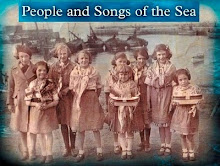
People and Songs of the Sea group

Yet, it is a sad truth that I and others are looking back on the fishing because it is an industry and a way of life undergoing the greatest of periods of change. The traditions, slipping away from us as water trickles through the fingers. As a child, I was down in Fisherrow all the time at my grandparents house by the sea. When people gathered together, I remember some would laugh in disbelief when my granda would say "they will rue the day, the big boats and those who sail into Scotland's fishing grounds - they are fishing the seas dry".


At Fisherrow, from the place
known locally as the back of Downies
Shona McMillan © All Rights Reserved
My granda' was the strongest advocate for sustainable fishing, back at a time when the phrase must seldom have been heard. In a complex issue, the boats began to dissappear from harbours around Scotland - the industry's problems NOT just self inflicted. Boats were decommissioned and still, fish stocks were sadly mismanaged.

So far removed from the fishing community, I feel that there have been times when those legislating the industry have made mistakes and some of these problems still continue today in the absurd situation where, by law, those who catch more than their quota are forced to dump it back over the side or face prosecution. A catch of dying fish, effectively polluting that area of the sea where it is dumped (other countries have spoken out in condemnation of this).


Death of a warrior, John Bellany © All Rights Reserved
John, once a fishermen from Port Seton, capturing this decommissioned boat
before it was broken up (as so many Scottish boats have been).

Amidst ever oppressive legislation and hardships of a life at sea - over the years people have left, retired and the young failed to enter the fishing. This pattern of change has impacted on the fishing community. In my home area, from Newhaven in Edinburgh, through East Lothian and on to Eyemouth in the Scottish Borders, now almost all the small fishing boats are gone, 13 fishermen working from Port Seton and only 10 local boats left at Eyemouth.


18.03.09: A community tribute photo of those representing:
Newhaven, Fisherrow, Port Seton, Eyemouth and beyond
People of the Sea, Shona McMillan © All Rights Reserved

It seems to me that NOW is the last opportunity to capture this passing way of life so that children, in years to come, can learn how life in their area once was. The developments in multi-media equipment need to be harnessed so, like the valued old postcard is in 2010, reflections of today will continue on in to tomorrow for a future generation to appreciate. 
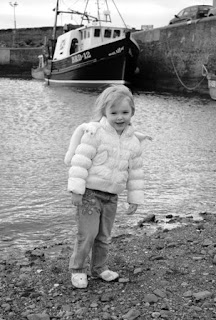
A Young Fisher Lass
Shona McMillan © All Rights Reserved
Just, as learning in my young life was greatly shaped and coloured by music and song - it seemed appropriate to me that my thoughts for the future just flowed out of me in this song. Maybe, a song I will get the opportunity to record as a sound track to a film. Just as John Bellany's paintings of the sea and fishing have reached a far wider audience than the fishing community, I believe too that there's a story here to be shared, a story told in local accents, photos old and new, in art, music and song.

I dedicate my song to my granda Billy Thorburn. Going to see the boats at the harbour with him, holding his hand as we walked along the prom at Fisherrow, my life was indeed 'carefree' in these days. It seemed that such a life could and would never change but his warnings for the future of the industry were correct and '"one day" the fishing boats from Fisherrow were all gone". He was right to see dark days ahead for the Fishing and, in my lifetime too, remarkable changes have been seen. Of course, we can not hold back time but nevertheless, we should recognise the importance of our culture and record a changing way of life before it is too late for us to do so...


Fisherrow Harbour in the gloaming
Shona McMillan © All Rights Reserved


A SONG FOR THE FISHING Shona McMillan ©

Friendship which travels, across the water
Ties that bind, through the family tree
A tide which pulls, the heart yet closer
Tho’ what is the future, for a child of the sea

Newhaven to Eyemouth, the people have gathered
In Cockenzie they joined, in their songs of the sea
People whose lives, were built through the fishing
The numbers they dwindle with each quota and fee

Death of a warrior, for a boat decommissioned
Like a death in the family, a farewell to the sea
Men in grey suits, do they know what we’re losing
The heritage of Scotland, of you, and of me.

So I’ll walk the shore, and I’ll sing of the fishing
Like Fisherrow fishwives, who passed music to me
But when I am gone, who will sing of the fishing
The Fisher Folk People, and Songs of the Sea

Against the shoreline, the waves will keep breaking
The moon and the seasons, will dictate the tide
But at sunset the boats, will they sail to the fishing
Or will this way of living, have long since died

Shona McMillan ©


The Girl Jean heads out from Port Seton at dusk
Shona McMillan © All Rights Reserved


My thanks to the Bellany family for letting me use John's inspirational painting "Death of a Warrior" to go with my song. In addition, my thanks to his son Paul Bellany who provides such timely answers for me in respect of all my many questions in trying to get a film made about the People of the Sea and their stories.

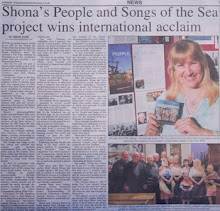
People and Songs of the Sea
Film project first reported by the Berwickshire News